
At 11pm at night, people lined up outside the Christian Louboutin boutique


At the edge of the Jardin d’Acclimatation in Paris’s Bois de Boulogne, after more than a decade in the making, the Fondation Louis Vuitton, Bernard Arnault’s private art museum par excellence designed by the starchitect Frank Gehry reigns. The exposition we saw had several surprising modern art presentations - some of which befuddled us.


We were mystified by a deck chair posed in front of a ticking metronome as art?


Andy Warhol’s Ten Portraits of Jews of the Twentieth Century (1980) depict renowned luminaries of Jewish culture: Sarah Bernhardt, Louis Brandeis, Martin Buber, Albert Einstein, Sigmund Freud, George Gershwin, Franz Kafka, the Marx Brothers, Golda Meir, and Gertrude Stein. Warhol referred to this pantheon of great thinkers, politicians, performers, and writers as his “Jewish geniuses.” Warhol’s iconic portraits attest to the lasting achievements and fame of these singular figures. Originally published as a portfolio of silkscreen prints on paper, Warhol was so pleased with the commercial success of his Ten Portraits that he decided to create additional versions of the series as silkscreen paintings on canvas.


Isa Genzken, Rose II, 1993-1997 — Hall
Rose II (see page 7) — a second version of a metal rose created between 1993 and 1997
for the city of Leipzig — is a monumentally impressive, and initially private homage to an entire community. Very early on she used the computer as a tool to determine the shapes of her sculptures, turning to direct contact with the material later in the 1980s — first plaster, then concrete, colored translucent resin, and ultimately mirrors, in slender sculpted shapes that echo modernist architecture. Since 1997, her assemblages, partly a fantasized translation of
the urban and social context, have originated from a Pop appropriation of consumer objects that liberates shapes and colors.
Rose II (see page 7) — a second version of a metal rose created between 1993 and 1997
for the city of Leipzig — is a monumentally impressive, and initially private homage to an entire community. Very early on she used the computer as a tool to determine the shapes of her sculptures, turning to direct contact with the material later in the 1980s — first plaster, then concrete, colored translucent resin, and ultimately mirrors, in slender sculpted shapes that echo modernist architecture. Since 1997, her assemblages, partly a fantasized translation of
the urban and social context, have originated from a Pop appropriation of consumer objects that liberates shapes and colors.

Another work was a film of a naked man ice skating. Sorry we cannot post videos on the blog.
Then we were off to meet Cindy Niekamp (her second trip during our 4 years here in France) and walk a few miles on the French version of the NY High Line (Promenade Plantée). She is contemplating renting a place in Paris after her retirement from PPG.

Not only does Paris have its own green haven converted from an old railway line but indeed, it was the original High Line, built sixteen years before the New York model and even served as inspiration to it’s American counterpart. NYC’s planning director Amanda Burden acknowledges that the model for the High Line was in fact la Promenade Plantée in Paris.

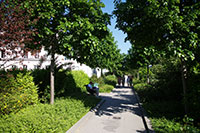
Promenade Plantée


We finished with a pause in front of a street performer, who happened to be an operatic soprano. A very large crowd gathered and showered her with their appreciation.


Loved your blog entries. Great pix and artistic info. Love that green dress you had on on the balcony patio. So pretty. Joyce
ReplyDelete